
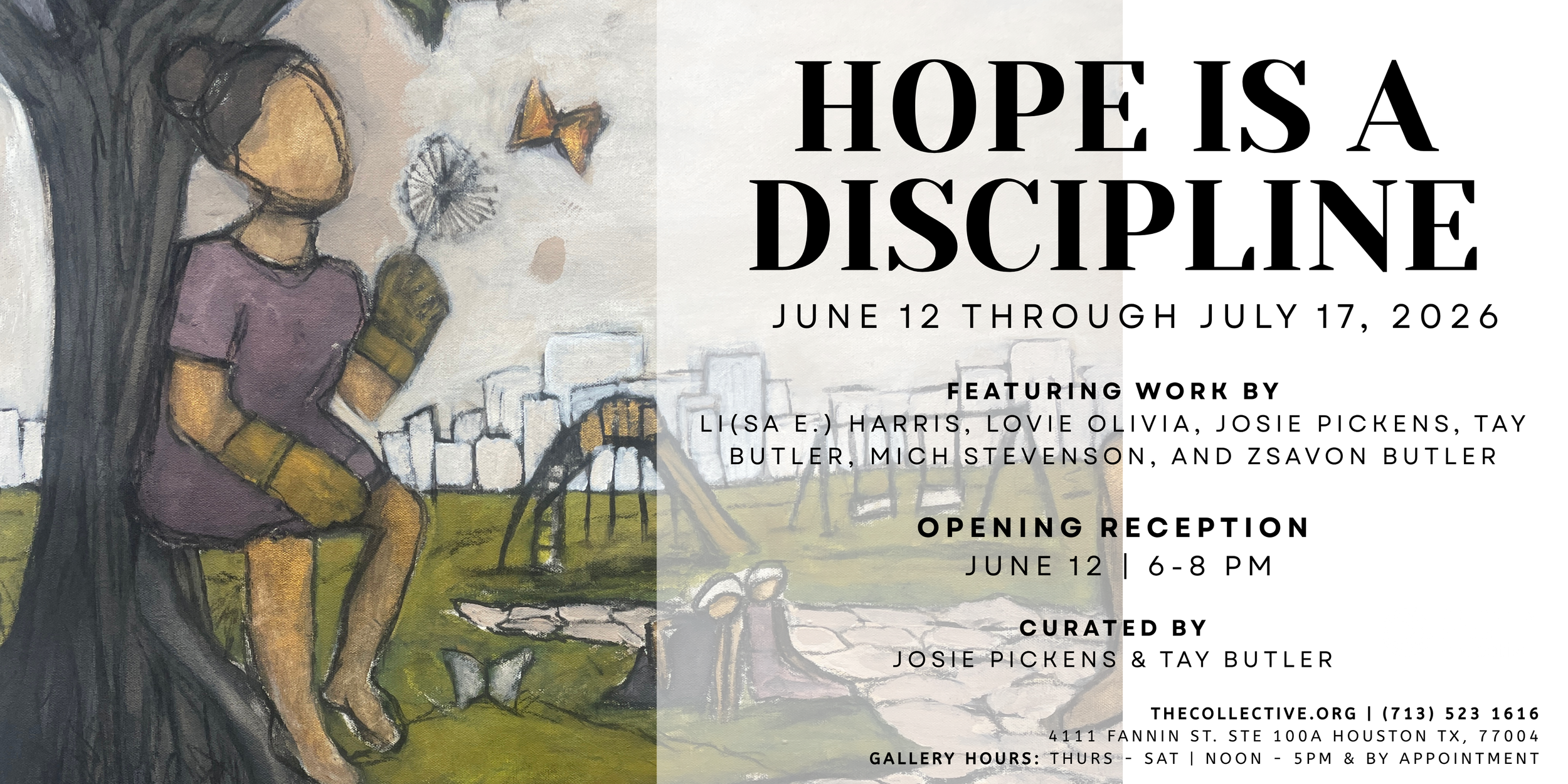
Hope is a Discipline begins with a question that lingers—what does it mean to keep going, to keep imagining, when the evidence around you suggests otherwise? Hope, here, is not presented as belief, but as a kind of behavior, something learned, repeated, carried. In the thinking of Mariame Kaba, it is a discipline, which is to say, a practice shaped as much by doubt as by faith.
The artists gathered in this exhibition understand that Black life has always existed in this tension between what is and what might be. Their work moves through love and resistance, memory and care, not as separate ideas but as overlapping conditions. There are moments of joy that feel deliberate, almost insistent. There are gestures that hold grief without trying to resolve it. And there are ways of being together—quiet, sometimes provisional—that suggest something like a future, even if it remains unnamed.
To think of hope as discipline is to accept that it does not arrive fully formed. It is built, piece by piece, in relation to others, in relation to the past, in relation to the limits placed on the present. The works in Hope is a Discipline do not argue for hope so much as they show what it looks like to live inside it, imperfectly, and to continue anyway.
Hope Is a Discipline brings together Black artists of all identities whose work confronts the conditions we are living under while reaching toward something more free and whole.
Co-curated by Josie Pickens and Tay Butler, the exhibition centers care, resistance, and imagination as ways we move toward liberation and remain in relationship with one another.
The exhibition takes its title from the work of visionary abolitionist organizer Mariame Kaba, who reminds us that hope is not passive—it’s something we choose and build together, especially in the face of ongoing harm.
Featuring work by Li(sa E.) Harris, Lovie Olivia, Josie Pickens, Tay Butler, Mich Stevenson, and Zsavon Butler, the exhibition spans visual art, sound, and performance. The works trace the realities of Black life shaped by surveillance, control, and abandonment, while also holding space for connection, resistance, and the work of becoming.
The exhibition opens with a public reception featuring remarks from the curators and participating artists. Public programming includes a listening session led by Tay Butler and a live performance by Li(sa E.) Harris, along with additional gatherings that invite participants to reflect, remain in relationship with one another, and consider how this work carries into the ways we live and care for each other.
“Hope is work”, says curator Josie Pickens. “It’s something we build in the middle of injustice, not after it. The artists in this exhibition are already living that out—creating ways to care for each other, to stay in relationship, and to imagine beyond the systems built for our demise.”
Hope Is a Discipline is presented at the Community Artists’ Collective, a long-standing space dedicated to Black artists and cultural work in Houston.